 RNDISaurus
No workarounds
Many Android phones tether only over RNDIS, and macOS has no driver for it. Until now, getting one meant giving something up.
RNDISaurus is a native RNDIS driver for Mac. Plug in your Android phone, turn on USB tethering, and you're online. No kernel extension, no Terminal, and your Mac's security stays on.


Built with DriverKit, Apple's framework for drivers that run outside the kernel. Your phone appears in System Settings like an Ethernet adapter.
No kernel extension, no Reduced Security, no Terminal commands. System Integrity Protection stays on.
The driver starts when you plug in your phone and stops when you unplug it.
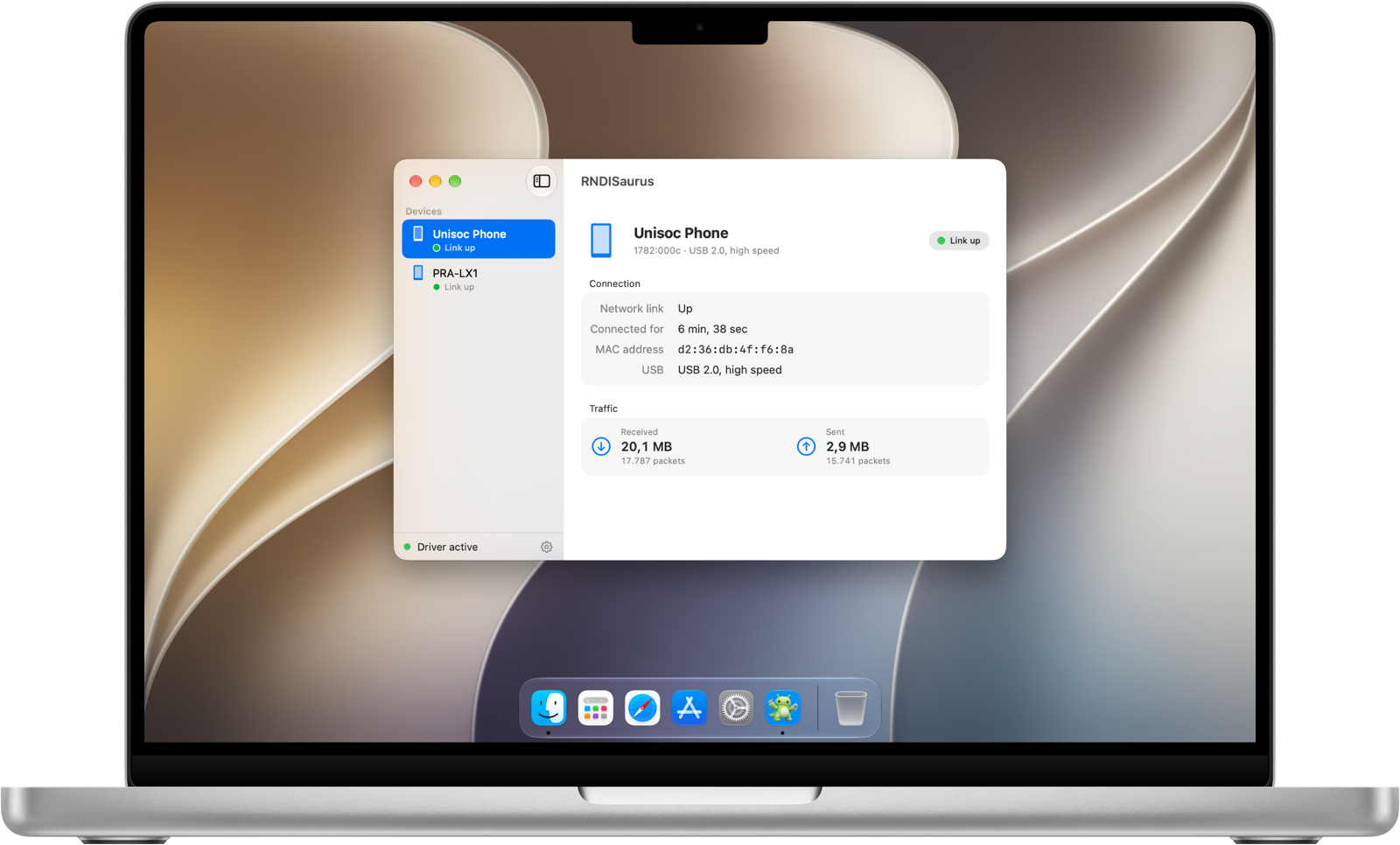
See each connected phone's link, address and traffic.
Many Android phones tether only over RNDIS, and macOS has no driver for it. Until now, getting one meant giving something up.
| RNDISaurus | Kernel extension | Command-line tool | |
|---|---|---|---|
| Full Security and SIP stay on | Yes | Reduced Security on Apple silicon | Yes |
| Nothing runs in the kernel or as root | Yes | Runs in the kernel | Runs as root |
| From the Mac App Store | Yes | No | No |
| A real network adapter in System Settings | Yes | Yes | Virtual, not in System Settings |
Coming from HoRNDIS? Here's how to switch. Not sure your phone needs a driver? Find out.
Android phones and Linux devices that tether over RNDIS, from these makers:
Apple approves drivers maker by maker. Is yours missing? Request it.
The driver is published on GitHub under the Mozilla Public License 2.0, with every release. The app is closed source.
Successor in spirit to HoRNDIS by Joshua Wise, and informed by David Brownell's Linux RNDIS drivers, ReRNDIS and TetherKit (prostec-labs, XiaoMiku01).
Only if it tethers over RNDIS. iPhones and phones that use NCM, like recent Pixels, work on a Mac without it, and RNDISaurus tells you when that's the case. How to tell.
macOS only lets RNDISaurus drive devices from makers Apple has approved. Request yours so it can be part of the next request to Apple. The same goes for Linux gadgets using the Linux Foundation or NetChip IDs, such as a Raspberry Pi.
No. The driver works on its own, and the app can install driver updates in the background.
Remove it, or any other RNDIS driver, before activating RNDISaurus. How to remove HoRNDIS.
Yes, with the public beta on TestFlight.
Support covers what each status in the app means. To report a problem, open Window › Diagnostics, click Copy Diagnostics, and paste the report into a GitHub issue or an email to info@n4h4.com, with your phone's model.